About Us
Our regional team with IPM, entomology, agricultural chemistry, geospatial analysis, ecoinformatics, economics, evaluation, and extension expertise is partnering with producers, crop consultants, industry, and extension personnel to develop corn earworm management solutions and deliver user-friendly resources. In combination, we deliver research-based vegetable IPM information directly to thousands of stakeholders annually and will compile sweet corn IPM and corn earworm management resources on this website.
Partners
Director
Kelly Hamby – University of Maryland
Expertise: Integrated pest management research and extension, including monitoring and understanding corn earworm resistance to Bt insecticidal proteins
Project role: Project director with specific focus on revising CEW thresholds in sweet corn and development of extension outputs
Website: www.hambylab.com
Co-Directors
Michael Crossley – University of Delaware
Expertise: Ecoinformatics and genomics, including monitoring insect dispersal across landscapes
Project role: Co-project director with specific focus on characterizing changes in CEW population patterns in response to climate and insecticides
Website: sites.udel.edu/agriculturalentomology
Galen Dively – University of Maryland
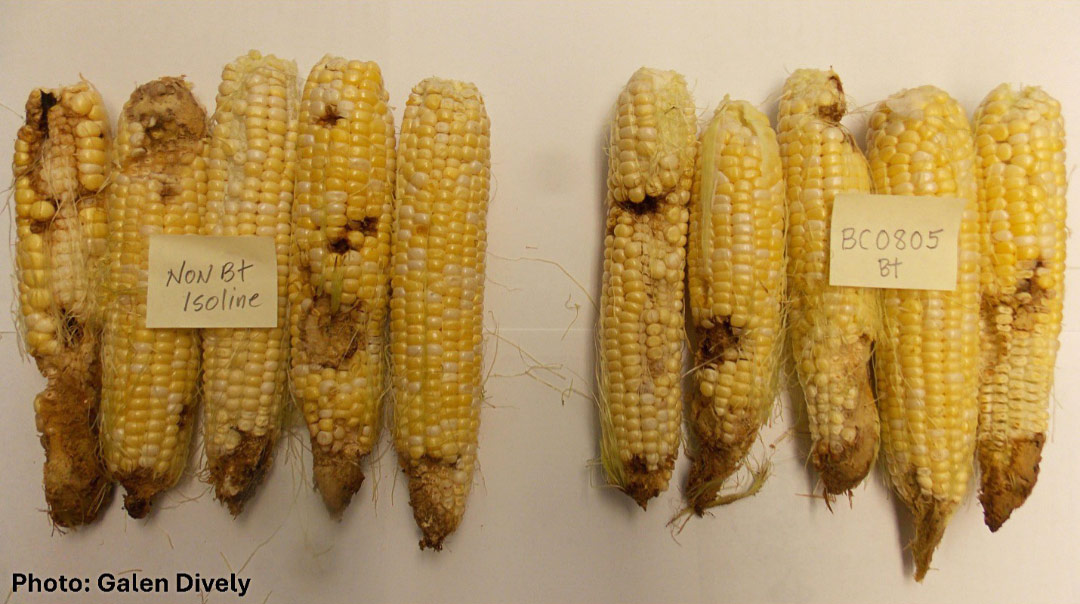
Expertise: Agricultural integrated pest management, resistance monitoring, and ecological assessment of the nontarget effects of Bt crops.
Project role: Co-project director with specific focus on a multistate sweet corn sentinel monitoring network for tracking field-evolved resistance to the Bt toxins.
Principal Investigators
Christophe Duplais – Cornell University
Expertise: Insect chemistry, agricultural chemistry, insect monitoring
Project role: Lead and coordinator of chemical analyses related to longevity of pheromone lures, and isotope analyses to determine AI overwintering site. Provide chemical information on adjuvants.
Deborah Grantham – Cornell University/Northeastern IPM Center
Expertise: The Northeastern IPM Center assists and participates in education, training, technical assistance, communications campaigns, partnership building, and evaluation including with respect to project impacts and adoption of IPM throughout the Northeast and across the country.
Project role: The Northeastern IPM Center will provide communication, social network enhancement, stakeholder engagement, evaluation of IPM adoption, and hosting of e-lists for collaborators and stakeholders. We will construct a project website, host and maintain the site, and track analytics on the use of the site. We will help measure changes in knowledge, attitudes, skills/actions, aspirations, and conditions described via methods that may include grower interviews, stakeholder surveys, cost-benefit analyses, webinar polling, and pre- and post-meeting evaluations, and write impact statements.
Website: www.northeastipm.org
Anders Huseth – North Carolina State University
Expertise: Insect ecology, resistance management, and insect monitoring
Project role: Coordination of corn earworm monitoring efforts in the southern sweet corn production region. Collaborator on projects testing earworm thresholds and control efficiency in Bt and non-Bt sweet corn.
Thomas Kuhar – Virginia Tech
Expertise: Applied insect ecology, integrated pest management, extension entomology.
Project role: Co-lead and coordinator for research aimed at improving sustainable integrated pest management programs for CEW including minimizing impact on non-target organisms. Virginia collaborator on projects that identify the best trap and pheromone lure combination for trapping CEW moths; evaluating dynamic action thresholds for timing insecticides to control CEW, determining the most IPM ad pollinator-compatible insecticide program for CEW control in Bt and non-Bt sweet corn, and monitoring CEW populations for resistance to Bt sweet corn.
James MacDonald – University of Maryland
Expertise: Economist who works on farm structure, contracting and agricultural marketing, commodity costs and returns, and competition and pricing in food and agricultural markets.
Project role: Estimate current on-farm costs of CEW control, and evaluate the financial impact of alternatives on costs and returns for different types of producers.
Brian Nault – Cornell University
Expertise: Applied insect ecology, pest management, extension entomology
Project role: Lead and coordinator for identifying the best trap and pheromone lure combination for trapping corn earworm moths. Collaborator on projects that evaluate dynamic action thresholds for timing insecticides to control CEW, determine the best bee-friendly insecticide program for CEW control in Bt and non-Bt sweet corn, and monitor CEW populations for resistance to Bt sweet corn.
Colby Silvert – University of Maryland
Expertise: Nonformal education, program planning and evaluation, innovation adoption in specialty agri-food systems, trained as a social scientist and a horticulturist
Project role: Oversee project evaluation of outcomes influencing stakeholders and Extension educators and conduct social science research to identify barriers and facilitators to the adoption of improved sweet corn IPM and corn earworm management
Website: agnr.umd.edu/about/directory/colby-silvert
Co-Principal Investigators
Jared Dyer – Cornell Cooperative Extension of Suffolk County
Expertise: Extension entomology, integrated pest management, biological control
Project role: Co-principal investigator in monitoring resistance to plant incorporated Bt toxins, refining decision support systems for sweet corn IPM programs, and delivering extension programs to local grower audiences.
Daniel Gilrein – Extension Entomologist, Cornell Cooperative Extension of Suffolk County
Expertise: Agricultural pest management, entomology extension, arthropod and plant problem diagnostics.
Project role: Regional collaborator investigating optimized corn earworm trapping, corn earworm overwintering survival, monitoring resistance to foliar-incorporated toxins, and contributing local-reared corn earworm specimens for migration studies.
Website: ccesuffolk.org/agriculture/entomology
Chris Jones – North Carolina State University
Expertise: Geospatial data analysis, spatially and temporally dynamic spread modeling, pest and disease modeling
Project role: Forecasting CEW population dynamics across the East Coast of the United States from current data. Forecasting future CEW dynamics due to climate change and other drivers.
Joseph LaForest – University of Georgia
Expertise: Technology, data management, and data visualization
Project role: Investigator focusing on improving ease of field data collection and using that information to inform grower decisions.
Website: agpestmonitor.org
Ross Meentemeyer – North Carolina State University
Expertise: Geospatial analytics, participatory modeling, landscape ecology
Project role: Participatory modeling of CEW population dynamics with stakeholders. Forecasting future CEW dynamics and exploring scenarios.
David Owens – University of Delaware
Expertise: Agricultural pest management, extension
Project role: Pyrethroid resistance monitoring and coordination. Collaborator on projects testing earworm thresholds, lures, and control efficacy and monitoring corn earworm in Delaware.
Collaborators
Heather Grab – Penn State
Expertise: Spatial data analysis with a focus on understanding large scale drivers of beneficial and pest arthropod abundance in specialty crops.
Project role: Provide current data on CEW population from the Pennsylvania monitoring network and support experimental project efforts with replications in Pennsylvania as needed.
Website: ento.psu.edu/directory/hlc30
Kristian Holmstrom – Rutgers University
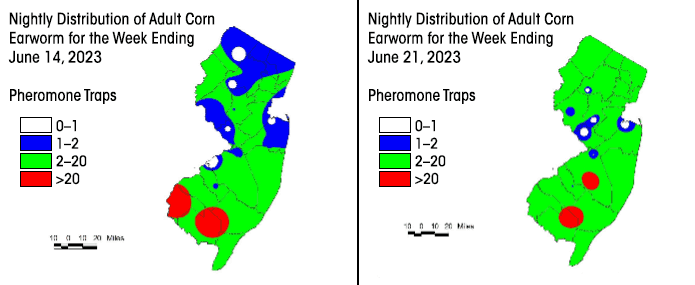
Expertise: IPM research and extension, with focus on the production of near real-time geospatial CEW moth population maps.
Project role: Unfunded collaborator contributing regular current and archival CEW population information as well as monitoring for Bt resistance.
Kemper Sutton – Virginia Tech
Expertise: Applied integrated pest management, insect ecology, extension specialist
Project role: Lead and coordinator for applied integrated pest management research such as insecticide bioassay and field trial evaluations, CEW trap type and lure evaluations, and Bt and non-Bt sweet corn resistance monitoring.
Veronica Yurchak – University of Maryland Extension
Expertise: Vegetable integrated pest management and sustainable production
Project role: Leads multistate sweet corn sentinel monitoring network for tracking field-evolved resistance to the Bt toxins